

 Posted by
 Should you buy a fixer-upper or a move-in-ready home? We break down the financial, emotional, and practical benefits of each to help you decide what’s right for your situation. The search for a home often leads to a defining crossroads: the charming but dated “fixer-upper” offered at a tempting price versus the polished, “move-in ready” home that commands a premium.
This choice is far more than a stylistic preference; it’s a strategic decision that pits potential equity against immediate convenience, and personal vision against the realities of time, budget, and stress.
Understanding the true, full-spectrum benefits and trade-offs of each path is essential to making a choice that aligns not just with your finances, but with your lifestyle, skills, and tolerance for uncertainty.
The primary allure of the fixer-upper is financial leverage and creative control. The upfront purchase price is typically lower, which can mean a smaller down payment, lower property taxes (initially), and potentially getting into a more desirable neighborhood than you could afford otherwise.
The core value proposition is the “sweat equity” opportunity, the potential to increase the home’s value significantly through renovations, building wealth through your investment of money, time, and labor.
Furthermore, you have the freedom to customize the home to your exact tastes from the ground up, creating a space that is perfectly tailored to your needs. For the right buyer, this process is not a chore but a rewarding project and a direct investment in their future net worth.
However, the benefits of a fixer-upper are heavily contingent on several critical factors. Your financial runway must extend far beyond the purchase price to cover renovation costs, which almost always exceed initial estimates.
You’ll need robust cash reserves or access to financing like a renovation loan. Time and tolerance for disruption are enormous factors; living in a construction zone for months or years is profoundly stressful. Perhaps most importantly, you need a realistic assessment of your skills and project management ability.
Misjudging the scope of work (especially in hidden areas like plumbing, electrical, or foundations) can turn a dream project into a financial and emotional nightmare. A fixer-upper is a high-risk, high-reward proposition that requires honest self-evaluation.
Conversely, the move-in ready home offers the profound benefit of immediate peace and predictability. You pay a premium for the privilege of walking in, unpacking, and starting your life without the dust, decisions, and contractor schedules.
The major systems, roof, HVAC, plumbing are typically updated and under warranty, providing significant protection from unexpected, costly repairs in the first few years. This path offers certainty of cost; your mortgage payment is your known maximum housing expense, allowing for easier budgeting.
For busy professionals, families with young children, or those who lack the desire or skill to manage renovations, this convenience and mental calm is worth every penny of the higher price tag.
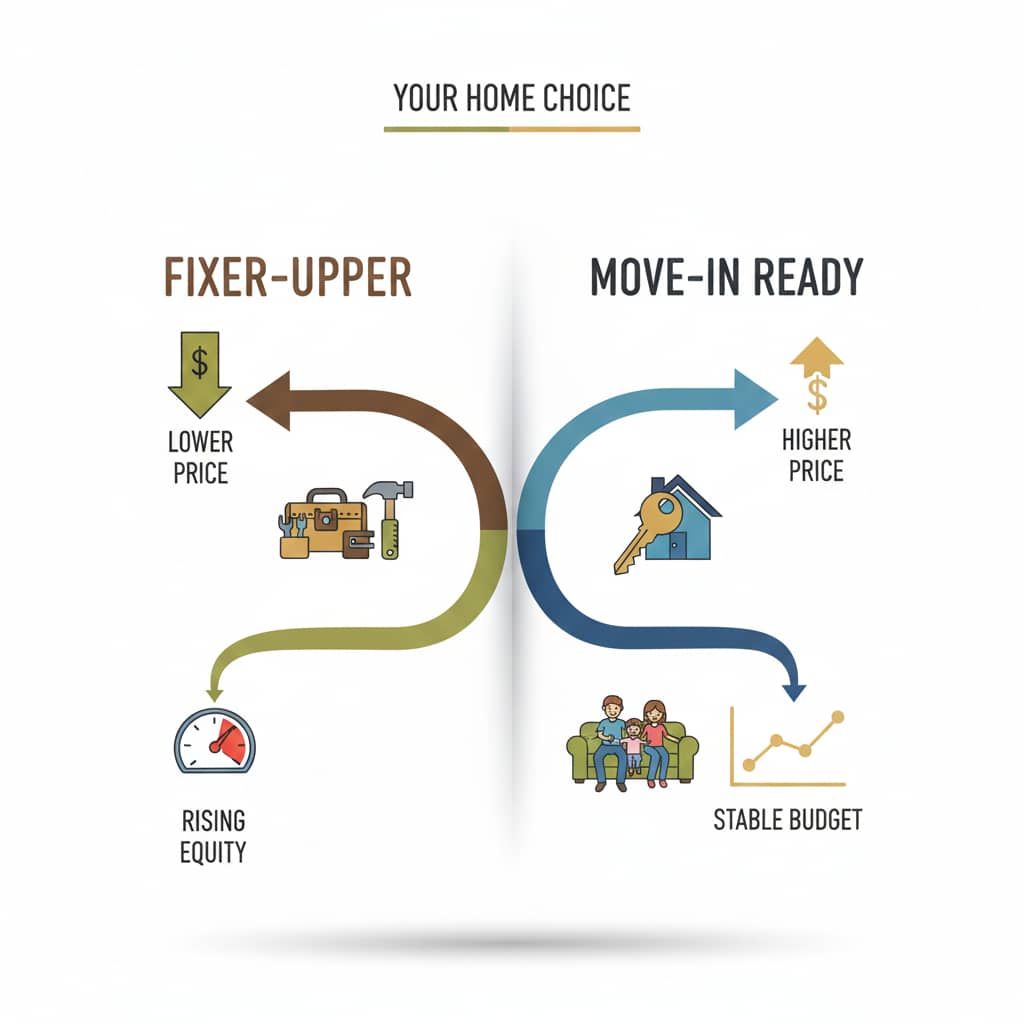
The trade-off for this convenience is a higher initial investment and less opportunity for rapid equity growth through improvements. You are paying for the previous owner’s taste and upgrades, which may not perfectly align with your own, leading to potential “re-renovation” costs down the line.
There’s also less opportunity to put a personal stamp on the home immediately without undertaking projects yourself. In a competitive market, move-in ready homes often attract multiple buyers, potentially leading to bidding wars that further inflate the price. This path prioritizes stability and lifestyle over potential financial optimization and customization.
Ultimately, the decision hinges on your personal calculus of value. The fixer-upper is a speculative investment of your time and resources, ideal for those with construction knowledge, flexible living arrangements, and a robust contingency fund.
The move-in ready home is a purchase of time, sanity, and certainty, ideal for those who value stability, have limited bandwidth for projects, or are in a competitive market where turnkey properties are the norm.
The smartest choice isn’t about which is universally better, but about which set of benefits, potential future wealth or present-day peace, better serves your life, your finances, and your vision for the future.
References
FastExpert. (2023, November 1). *Should I buy a fixer-upper or move-in ready?*. Retrieved from https://www.fastexpert.com/blog/should-i-buy-a-fixer-upper-or-move-in-ready/
Evergreen Home Loans. (2025, February 17). *The perks of buying a fixer-upper*. Retrieved from https://www.evergreenhomeloans.com/evergreen-insights/posts/turning-potential-into-reality-the-perks-of-buying-a-fixer-upper
Clark Hall Doors. (2025, November 19). *Best ROI home improvements*. Retrieved from https://clarkhalldoors.com/home-exteriors/roi-home-improvements/
PrimeLending. (2023, September 10). *A fixer-upper vs move-in ready home*. Retrieved from https://blog.primelending.com/fixer-upper-vs-move-in-ready-home/
Graystone Investment Group. (2025, August 10). *The risks and rewards of buying fixer-uppers*. Retrieved from https://graystoneig.com/articles/the-risks-and-rewards-of-buying-fixer-uppers