
 Posted by
 When my husband and I started house hunting, I had a list of non-negotiables that looked pretty standard: three bedrooms, good school district, updated kitchen, backyard big enough for the dog. But I also had a dream I was almost embarrassed to admit. I wanted a dedicated space to work out.
Not a corner of the bedroom where I’d trip over a yoga mat, not the garage with its oil stains and spiders, but an actual room where I could move, sweat, and not feel like I was in anyone’s way. Finding out how to assess a home’s potential for a home gym became my secret mission during every open house.
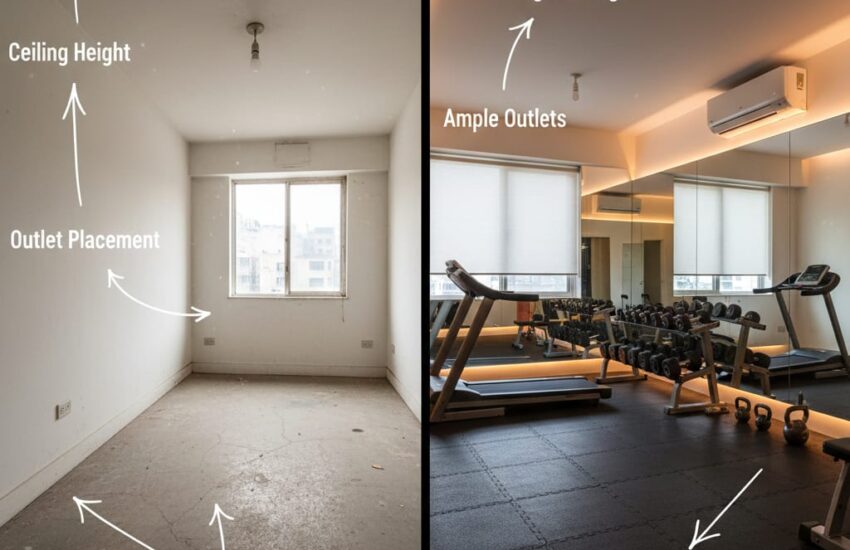
And let me tell you, I learned the hard way that not all spaces are created equal. The room that looks perfect for a treadmill might actually be a nightmare waiting to happen. Let me start with the most obvious factor, the one everyone thinks about first: square footage. You need enough space for the equipment you want and, just as importantly, enough space to use it safely.
I walked into one house with what the listing called a “bonus room” that seemed ideal until I actually stood in it. The ceilings were so low that my husband, who’s six feet tall, could almost touch them with his fingertips. Great for storage, terrible for overhead presses or jump rope.
When you’re assessing a room, don’t just look at the floor. Look up. Look around. Imagine yourself moving in that space. If you’re planning to do yoga, you need room to extend your arms in every direction without hitting a wall. If you want a rowing machine, you need length. If you’re dreaming of a Peloton, you need clearance behind the bike for dismounting safely. Bring a tape measure to showings.
Better yet, bring a list of your equipment dimensions and compare them to the actual room while you’re standing in it. But size is only the beginning. The next thing I learned to check, the hard way, after we bought a house with a “perfect” gym space that turned out to be unusable, is the floor.
My first attempt at a home gym was in a converted sunroom. Gorgeous light. Terrible floor. It was tile over a concrete slab, and within weeks of setting up my weights, I realized my mistake. Dropping a dumbbell wasn’t just loud; it was destructive. Every impact echoed through the room and probably through the foundation. I ended up buying expensive rubber mats that helped but never fully solved the problem.
Now I know: the ideal gym floor is concrete slab with the ability to add cushioning, or sturdy subfloor on ground level that can handle impact. Upper floors are trickier. If the room you’re eyeing is above a living space, consider what your jumping jacks or treadmill runs will sound like to the person below.
Some homes are built with better soundproofing than others, but unless you’re ready to renovate, it’s worth being realistic about noise transmission. Then there’s the ceiling. I already mentioned height, but there’s more to consider. If you’re planning to hang anything, a heavy bag, gymnastics rings, or a TRX system, you need to know what’s above that drywall.
Is there a beam you can anchor into? Or are you looking at hollow space that won’t support any weight? I learned to knock on ceilings during showings and ask about construction. Sellers might not know, but sometimes you can peek into attics or mechanical spaces to get a sense of the structure.
Ventilation is another factor I initially overlooked. A room without windows might seem private and cozy, but after twenty minutes of high-intensity interval training, you’ll be gasping for air. If the room doesn’t have windows, check for existing HVAC vents and consider whether they can adequately cool and refresh the space. Ceiling fans help.
Portable fans help more. But the best gym rooms have at least some ability to bring in fresh air or move stale air out. Lighting matters more than you’d think. Not just for ambiance, although exercising in a dark, dreary room is a great way to kill motivation, but for safety.
You need to see what you’re doing. You need to avoid tripping over equipment. If that’s part of your practice, you need to check your form in a mirror. Natural light is wonderful, but if the room has none, assess the existing electrical. Can you add brighter fixtures? Are there enough outlets for floor lamps if needed?
Speaking of outlets, count them. A home gym these days often means plugged-in equipment. Treadmills, exercise bikes, sound systems, fans, space heaters in winter, phones or tablets for streaming workouts. I learned this the expensive way when I realized my “perfect” room had exactly one outlet, on the wrong wall.
Extension cords become tripping hazards. So when you’re learning how to assess a home’s potential for a home gym, get specific about your electrical needs. Temperature control is another consideration I didn’t appreciate until I spent a summer trying to work out in a room that had no separate climate control.
The house’s central AC barely reached that far corner, and by July, the room was unbearable. Now I look for separate zones, mini-split potential, or at least windows that can accommodate a window unit if needed. Privacy matters too, especially if you’re someone who doesn’t want an audience while gasping through burpees.
I toured a house with a gorgeous basement that would have made an amazing gym, but the only windows were street-facing at eye level for anyone walking by. Not my vibe. Curtains help, but they also block light and view. Think about whether you want to be seen, and whether the room’s location in the house gives you the seclusion you need.
Access is another practical consideration. If your gym is in the basement, you’ll be carrying equipment down stairs. If it’s on the second floor, you’ll be hauling weights up. Neither is impossible, but it’s worth thinking about before you buy. Also consider the path from your parking or entry to the gym.
Are there doors wide enough for equipment delivery? Will you have to navigate tight corners or narrow hallways with a bulky treadmill box? One of the smartest things I did during our search was bring a fitness-minded friend to showings.
She noticed things I missed. “That floor will be murder on your knees,” she said in one house. “Where will you put your mat so it’s not in the walking path?” in another. Fresh eyes, especially eyes that understand how bodies move through space, are invaluable.
After we finally bought our current home, a house with a converted garage that makes an absolutely perfect gym, I realized something important. The perfect gym space doesn’t have to be perfect from day one. It needs potential. It needs the bones that can be transformed. A concrete floor that can be covered. Walls that can hold mirrors.
Space that can be divided if needed. Adequate power for your toys. And most of all, a location in the house that won’t drive you crazy with noise, temperature, or accessibility issues. If you’re in the middle of house hunting and dreaming of your own fitness sanctuary, take this list with you. Measure. Knock on ceilings. Count outlets.
Imagine yourself in that space not just on moving day, but on a rainy Tuesday in February when motivation is low and comfort matters most. The right room won’t just hold your equipment. It will invite you in, day after day, and become the place where you get stronger, healthier, and more yourself.
There’s so much more to think about when buying a home than just the kitchen and bedrooms, and we’ve got plenty of articles on our site to help you navigate every decision. From assessing neighborhood walkability to understanding hidden costs of ownership, we’re here to make your home buying journey smarter and less stressful. Head over and explore, your dream home is out there, and we’ll help you find it with eyes wide open.
References
Sunny Health & Fitness. (2025, July 20). *Home gym design factors: Maximize your space for maximum results*. Retrieved from https://sunnyhealthfitness.com/blogs/products/build-home-gym
Tonal. (2022, October 31). *11 expert tips for the best home gym setup*. Retrieved from https://tonal.com/blogs/all/best-home-gym-setup
Gym Mat. (n.d.). *Turn your home into a training room! We explain the space and cost required*. Retrieved from https://gymmat.jp/en/blogs/shopping/home-gym-training-room
BodySculpture. (2025, October 2). *Top 5 mistakes to avoid when buying home gym equipment*. Retrieved from https://www.bodysculpture.co.uk/blog/top-5-mistakes-to-avoid-when-buying-home-gym-equipment
Jerai Fitness. (2025, November 19). *How to set up a home gym in a small room in India: Space-saving guide*. Retrieved from https://jeraihomegym.com/blogs/home-gym/small-room-home-gym-setup