

 Posted by
 My first year in real estate taught me a hard lesson: closing a big deal does not mean you are rich. I celebrated my first commission check like I had won the lottery, and by the end of the next month, I was scraping together quarters for gas. The money had come and gone. I had no system. No plan. No savings. Just a lot of lessons learned the hard way.
Real estate agents are self-employed, which means no employer withholding taxes, no company retirement plan, and no steady paycheck. You get a 1099-NEC instead of a W-2. That commission check is your gross income, not your take-home pay. I learned that if I wanted to survive, I needed a system that could turn unpredictable income into predictable stability.
The first thing I had to accept was that my budget needed to be based on my worst months, not my best. I calculated my bare minimum living expenses, rent, groceries, health insurance, and car payment, and used that as my baseline. During the slow months, I could survive on that number. During the busy months, I did not blow the surplus. I saved it, allocated it, and let it carry me through the lean times. I had to stop acting like every closing was the last one I would ever have.
I also had to stop mixing personal and business finances. For a while, I was using personal accounts to fund business expenses, and it was damaging my credit and making tax time a nightmare. I opened a separate business checking account and a dedicated business credit card. Every commission check went into the business account first. From there, I allocated it to different “buckets”.
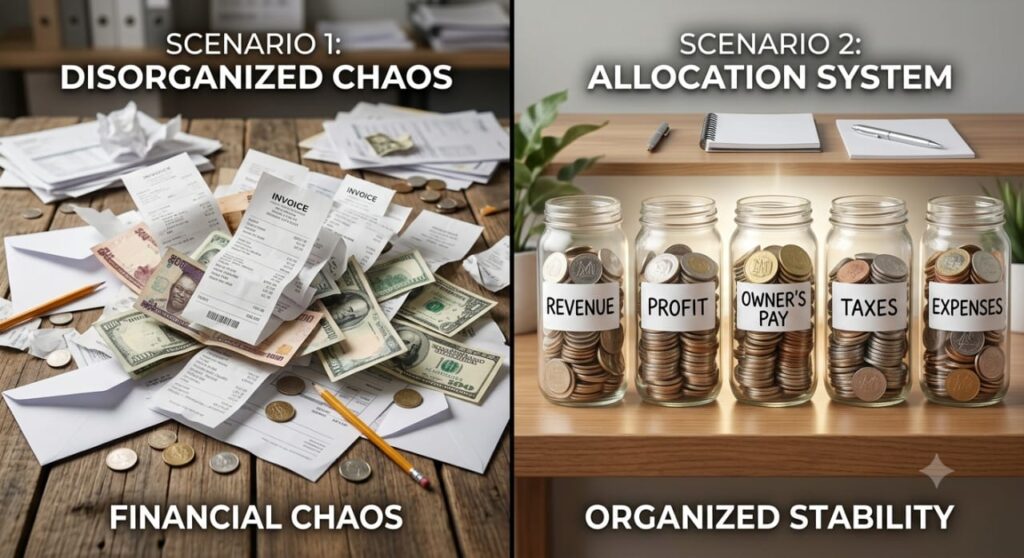
The system that finally worked for me was based on allocating every commission check immediately. I set up five accounts: revenue, profit, owner’s pay, taxes, and operating expenses. The commission check lands in the revenue account, and then I transfer fixed percentages to the other four. I cannot tell you how much stress this reduced. When tax time came, the money was already there. When I had a slow month, my owner’s pay account had reserves. When I needed to invest in marketing, my operating expenses account told me exactly what I could afford.
The tax account was the hardest lesson. Self-employment tax is 15.3% in 2026, covering both the employee and employer portions of Social Security and Medicare. On top of that, you owe federal and state income tax. I learned to set aside at least 25 to 30% of every commission check for taxes. I put that money into a high-yield savings account so it earned interest while it sat waiting for my quarterly estimated payments. I stopped treating the tax money like surplus. It was never mine to spend.
Tax deductions became my lifeline. As a self-employed realtor, you can deduct nearly every business expense: mileage, home office, marketing, association dues, professional development, and even client gifts up to twenty-five dollars per person per year. I started tracking my mileage using the IRS standard rate, which was 70 cents per mile in 2025. I logged every mile I drove to showings, open houses, and client meetings. I kept receipts for everything. Those deductions reduced my taxable income significantly and kept more money in my pocket.
Retirement planning was another blind spot. Without an employer-sponsored 401(k), I had to create my own plan. I set up a SEP IRA, which allowed me to contribute up to 25% of my net earnings, up to $70,000 in 2025. I also considered a Solo 401(k), which offers Roth options and catch-up contributions, but the SEP was simpler to manage with no employees. Every time I closed a deal, I transferred money into that retirement account just like I did with my tax account. I treated it as non-negotiable.
I also learned to protect my personal finances by establishing a strong emergency fund. I aimed for six to twelve months of expenses because a market downturn could mean months without a closing. I kept that fund in a high-yield savings account where it was accessible but separate from my daily spending.
Finally, I realized that my business structure mattered. I consulted a tax professional about whether to form an LLC or elect S-Corp status. An S-corp can reduce self-employment taxes by allowing you to pay yourself a reasonable salary and take the rest as dividends, which are not subject to self-employment tax. That structure saved me thousands of dollars once my income increased.
Managing finances as a self-employed realtor is not easy. It requires discipline, systems, and a willingness to live below your means even when you are flush with cash. But the peace of mind that comes from knowing your taxes are paid, your bills are covered, and your future is funded is worth every ounce of effort. You are not just selling houses. You are building a business and a life. Treat your money like the foundation it is.
There is so much more to learn about building a financially healthy real estate career. Our website is filled with articles on tax planning, retirement options, and business growth strategies. Head over and explore, because the best investment you can make is in yourself and your future.
References
National Association of Realtors. (2025, November 15). *10 essential tips for smart money management*. https://www.nar.realtor/news/wellness/10-essential-tips-for-smart-money-management
Collective. (2023, December 4). *Bookkeeping for real estate agents: A complete guide*. https://www.collective.com/blog/bookkeeping-guide-real-estate-agents
Beancount.io. (2025, October 22). *Financial management guide for real estate professionals*. https://beancount.io/blog/2025/10/16/financial-management-guide-for-real-estate-professionals
GJR Consulting. (2025, January 16). *Top accounting tips for realtors to stay organized in 2025*. https://gjrconsultinginc.com/top-accounting-tips-for-realtors-to-stay-organized-in-2025/
PeaceLink Financial Planning. (2025, May 4). *Financial planning for real estate agents & the self-employed: A practical guide*. https://www.peacelinkfp.com/financial-planning-for-real-estate-agents-and-the-self-employed-a-practical-guide