
 Posted by
 Crime rates directly impact your home-buying decision. Learn how to research neighborhood safety, interpret crime data, and assess security to find a home where you feel truly secure. The search for a home is a search for sanctuary. Beyond square footage and curb appeal lies a fundamental, often unspoken question: “Will I feel safe here?”
The perceived and actual safety of a neighborhood is not a secondary feature; it is a primary pillar of value, daily peace of mind, and long-term investment stability. While crime statistics offer a crucial starting point, understanding their true impact requires looking beyond raw data to a more nuanced assessment of environment, community, and personal perception. This due diligence is essential, as safety concerns can influence everything from your family’s daily routine to your home’s future resale value and insurability.
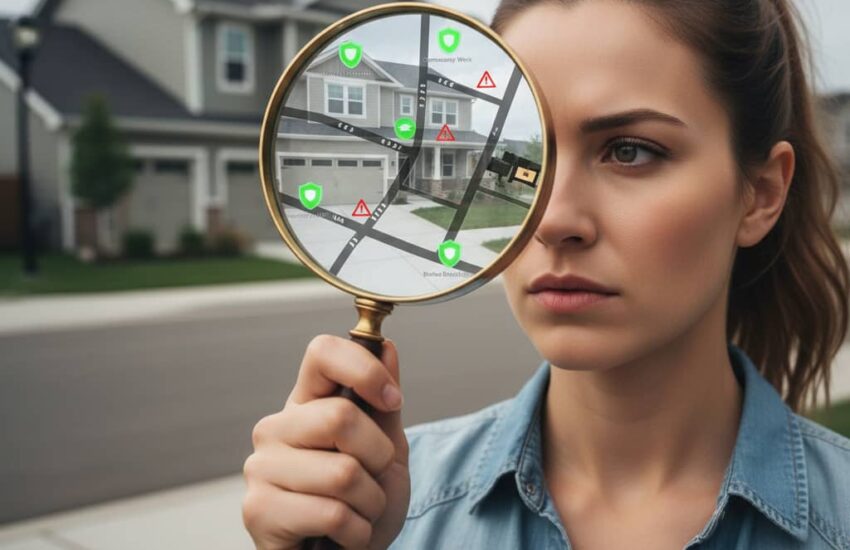
Begin with data, but know its limits. Online resources like local police department crime maps, NeighborhoodScout, and SpotCrime provide valuable quantitative snapshots. Look for types of crime (violent vs. property), frequency, and trends over time is crime decreasing, stable, or rising? Crucially, understand the geography.
A high-cime rate in a dense commercial district two miles away has a different implication than a pattern of burglaries on the specific streets you’re considering. Data provides the “what,” but it rarely explains the “why” or the “where.” Use it to identify areas for deeper, boots-on-the-ground investigation rather than as a sole verdict.
Your most powerful research tool is a strategic, multi-time neighborhood visit. Drive through the area at different times: on a Tuesday morning, a Friday evening, and a late Saturday night. Observe the environment. Are homes well-maintained with visible security features? Are streets well-lit? Are parks actively used by families, or are they deserted?
Look for subtle indicators of community health, neighbors chatting, kids playing, local businesses thriving. Visit the closest convenience store or coffee shop; these are informal community hubs. Trust your instincts. Does the area feel comfortable and cared for, or neglected and tense? This qualitative assessment provides context the statistics cannot, revealing the neighborhood’s lived reality.
Safety is deeply tied to community infrastructure and engagement. Research what proactive measures are in place. Does the neighborhood have an active Neighborhood Watch program or a community Facebook group where residents communicate? Are there security patrols in a gated community or condo complex? Investigate the proximity and visibility of “eyes on the street”, is it near a school, a library, or a busy, well-trafficked commercial corridor that sees constant activity?
A vibrant, engaged community is often the strongest deterrent to crime. Furthermore, assess the police and emergency services response time for the area, as this directly impacts risk and your sense of security.
Finally, consider the direct practical impact on your buying process. Lenders and insurers absolutely factor crime data into their risk models. High crime rates can lead to higher homeowners insurance premiums or, in extreme cases, difficulty securing coverage. For resale, a neighborhood’s safety reputation is a top factor for future buyers, directly affecting your property’s marketability and appreciation potential.
Your personal lifestyle will also be shaped by it. Will you feel comfortable walking the dog after dark? Will you need to invest in a full security system? Understanding these layers empowers you to make an informed choice, balancing the statistical reality with your personal risk tolerance, ultimately finding a home that is not just a structure, but a true and secure haven.
References
Journalist’s Resource. (2020, December 2). *The impact of crime on property values: Research roundup*. Harvard Kennedy School. Retrieved from https://journalistsresource.org/economics/the-impact-of-crime-on-property-values-research-roundup/
Proximitii. (2025, September 9). *How local crime and safety scores affect home value*. Retrieved from https://www.proximitii.com/blog/how-local-crime-and-safety-scores-affect-home-value/
Ihlanfeldt, K., & Mayfield, T. (2014). *Estimates of the impact of crime risk on property values from Megan’s Laws*. American Economic Review. (Cited in crime-property value studies)
Odufuwa, B. O., et al. (2020). *Effect of neighborhood security on housing price in Lagos*. American Journal of Economic Research and Economics, 5(4), 44-52. https://doi.org/10.11648/j.ajere.20200504.11
Akinwale, O. P. (2024). *Effect of neighbourhood crime on residential property values*. Federal University of Technology Minna Repository. Retrieved from http://irepo.futminna.edu.ng:8080/jspui/handle/123456789/29301