
 Posted by
 Buying a home? Learn how to strategically assess proximity to public transit, schools, hospitals, and amenities. This guide helps you evaluate convenience, walkability, and future value. The adage “location, location, location” is real estate’s universal truth, but its modern meaning extends far beyond the neighborhood name.
Today, a home’s true location is defined by its functional connectivity, the daily ease with which you can reach work, essentials, and leisure. A beautiful house can feel like a prison if it adds hours of commuting or requires a car trip for every errand.
Conversely, a modest property in a hyper-connected area can dramatically enhance your quality of life and long-term investment. Assessing this proximity isn’t just about measuring distance on a map; it’s a multi-layered investigation into your future daily routine, costs, and the community’s evolving character.
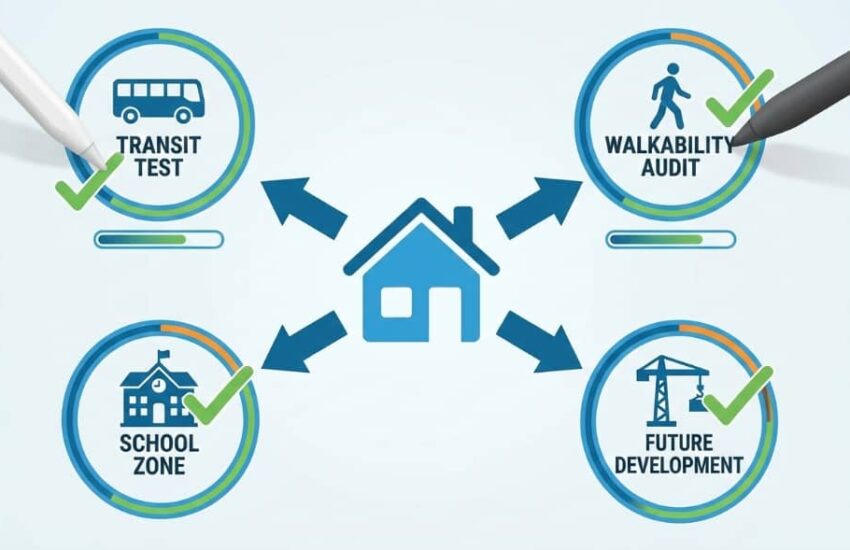
Your investigation should start with the most impactful factor for most buyers: commute and transportation access. For public transit users, this means moving beyond the simple “near a bus stop” claim.
Conduct a real-world test during your actual commute hours. Use apps like Google Maps or Transit to check real-time schedules and travel times to your workplace, not just station proximity.
Is the walk to the stop or station safe, well-lit, and pleasant in all weather? If driving is your primary mode, map the drive during both rush hour and off-peak times to gauge true variability. Crucially, investigate traffic flow patterns and any known future road projects (like expansions or lane reductions) that could alter your commute. The five-minute weekend test drive is a dangerous illusion.
A “walk score” from sites like Walk Score.com is a helpful starting point, but verify it with your own legs. Take a walk from the house. Are sidewalks present and in good repair? Are crossings safe? Does the route feel inviting or forbidding? Evaluate the quality and mix of amenities.
Are there multiple grocery options, or are you reliant on a single, expensive convenience store? A vibrant mix of retail and green space signals a resilient, desirable neighborhood that supports daily life without constant car use.
For families or future planning, schools and essential services require deep due diligence. Proximity to a highly-rated school district is a major value driver, but don’t just rely on district boundaries. Research the specific assigned schools’ ratings, programs, and walk zones.
If you have young children, test the walk or bike route to school for safety. Similarly, assess proximity to healthcare. How far is the nearest reputable urgent care center, pediatrician, or major hospital? In an emergency, minutes matter. Also, consider practical services like a post office, laundromat, or vet clinic. This network of essentials forms the safety and convenience net for your household’s daily life.
Finally, adopt a future-oriented lens. Investigate municipal planning documents or local news for upcoming developments. Is a new light rail line or a major employer planned nearby? This could significantly boost property value and connectivity. Conversely, is a large retail complex or highway slated for construction that could increase traffic and noise? Assess the neighborhood’s trajectory.
Are local businesses thriving, with new, independent shops opening? This indicates investment and desirability. Are there many “for rent” signs or boarded-up storefronts? This could signal a decline. Your assessment should balance the convenience of today with the potential of tomorrow, ensuring the location you choose supports not just your immediate move-in day, but your life for the next five to ten years. By layering these assessments, you move beyond a simple address to truly understanding the home’s place in your world.
References
National Association of Realtors. (2025, October 28). *Consumer guide: Real estate sales contract contingencies*. Retrieved from https://www.nar.realtor/the-facts/consumer-guide-real-estate-contract-contingencies
Zillow. (2025, October 6). *What are real estate contingencies?*. Retrieved from https://www.zillow.com/learn/real-estate-contingency/
Redfin. (2025, October 8). *8 top contingencies in real estate*. Retrieved from https://www.redfin.com/blog/contingencies-in-real-estate/
Advantage Real Estate. (2025, September 12). *A seller’s guide to buyer contingencies*. Retrieved from https://www.advantagerealestate.com/blog/a-sellers-guide-to-buyer-contingencies.html
Graystone Investment Group. (2025, August 10). *Real estate contingencies: Protecting contract & investment*. Retrieved from https://graystoneig.com/articles/real-estate-contingencies-guide-to-protecting-your-contract-investment