

 Posted by
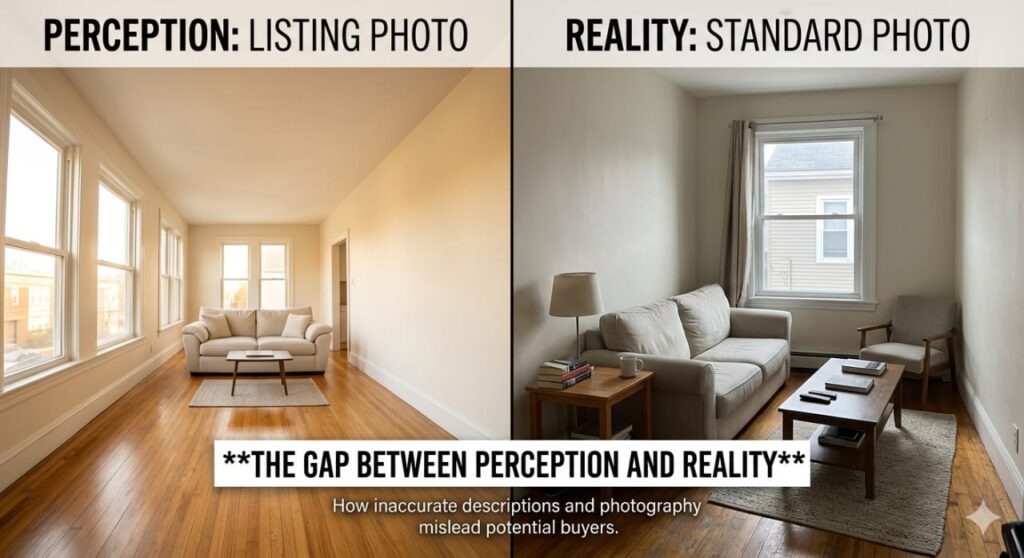
 I fell in love with a listing. The photos were gorgeous, sunlight streaming through tall windows, a renovated kitchen with marble counters, a backyard that looked like a private garden. The description promised “spacious rooms,” “modern updates,” and “a tranquil oasis steps from downtown.” I booked a showing within hours.
The reality was different. The “spacious” living room barely fit a standard couch. The “modern updates” stopped at the kitchen; the bathroom still had avocado green tile from 1972. The “tranquil oasis” backed up to a busy road, and “steps from downtown” meant a forty-five minute walk. I felt cheated, angry, and utterly exhausted by the wasted afternoon.
That experience taught me something I’ve never forgotten: understanding the importance of accurate property descriptions isn’t just about honesty, it’s about respect for everyone’s time, money, and sanity. Property descriptions are the bridge between a listing and a showing. They’re what convinces a buyer to take the next step. When that bridge is built on exaggeration or outright falsehoods, the whole process breaks down.
Sellers and agents who inflate descriptions might get more showings initially, but they pay for it later. Buyers arrive expecting one thing and find another. Resentment builds. Offers don’t materialize. The property sits on the market longer than it should, accumulating days on market like a scarlet letter. By the time the seller finally corrects the description, the damage is done.
I’ve seen this happen again and again. The “cozy” bedroom that barely fits a twin bed. The “newly updated” kitchen with appliances from the Clinton administration. The “low-maintenance yard” that’s entirely concrete. Each exaggeration feels small in isolation, but together they paint a picture that doesn’t exist. And the buyer who shows up to that nonexistent house doesn’t feel curious; they feel deceived.
Accurate descriptions protect everyone. They set clear expectations. They attract buyers who are actually interested in what the property offers, not what someone wished it offered. They build trust between agent and client, trust that matters when the negotiation gets hard.
For buyers, learning to read past the fluff is an essential skill. “Charming” often means small. “Fixer-upper” means work. “Opportunity” means deferred maintenance. “Cozy” is almost always code for cramped. But there’s a difference between marketing language and outright deception. A good agent will help you translate the listing into reality.
The best descriptions are specific, honest, and detailed. They don’t say “spacious”; they give square footage. They don’t say “updated”; they list what was updated and when. They don’t say “close to downtown”; they give distance in miles or minutes. Specificity is the enemy of disappointment.
When I finally bought my home, my agent taught me to compare the description against public records. Square footage in the listing should match tax records. Bedroom and bathroom counts should be legal, not aspirational. A “finished basement” needs permits and proper egress. She had horror stories about buyers who discovered after closing that the “extra bedroom” was never permitted, that the “updated electrical” was a fire hazard, that the “new roof” was three layers of old shingles.
For sellers, the temptation to exaggerate is real. You want your home to look its best. You want to highlight every positive feature. But stretching the truth almost always backfires. Buyers will notice the discrepancy between description and reality. They’ll wonder what else you’re hiding. Trust, once broken, is nearly impossible to restore.
The legal risks matter too. Misrepresenting a property can lead to lawsuits, especially when the misrepresentation involves square footage, property boundaries, or material defects. A buyer who relies on an inaccurate description and suffers damages as a result may have grounds to sue. That’s not just bad business; it’s legally dangerous.
I remember a listing for a condo that described “panoramic city views.” The reality was a sliver of sky between two taller buildings. The buyer, who’d paid a premium for those views, sued for misrepresentation and won. The agent’s license was suspended. All over a few words that could have been written more honestly.
The rise of online listings has made accuracy even more critical. Buyers scroll through hundreds of properties, clicking only on those that catch their eye. An inflated description gets clicks, sure, but those clicks come from the wrong people, people who will leave disappointed, who won’t make offers, who will remember your name for the wrong reasons.
The best agents understand that accurate descriptions are a form of respect. They respect the buyer’s time by showing them only what they actually want. They respect the seller’s goals by attracting serious, qualified buyers who won’t be disappointed upon arrival. They respect their own reputation by building trust that lasts beyond a single transaction.
When I finally found my home, the description was boring. “Three bedroom, two bathroom. One thousand eight hundred square feet. Updated kitchen in 2018. New roof in 2020. Quarter mile to the train station.” No fluff. No exaggeration. Just facts. And those facts were exactly what I needed to know that this house was worth my time.
The house itself was better than the description. The photos hadn’t captured how bright the morning light was. The words hadn’t conveyed the quiet of the street. But nothing was promised that wasn’t delivered. That honesty made me trust my agent and trust the seller. And that trust made the whole process smoother.
Accurate property descriptions aren’t about selling. They’re about matching. Matching buyers to homes that actually fit. Matching expectations to reality. Matching trust to transaction. When the description is right, everyone wins.
There’s so much more to learn about navigating real estate listings and finding your dream home. Our website is filled with articles on reading between the lines, asking the right questions, and working with trustworthy agents. Head over and explore, because the right home is out there, but you’ll only find it when the words tell the truth.
References
Michigan Department of Attorney General. (2024, March 22). *AG Nessel warns renters, homebuyers of fraudulent real estate ads*. https://www.michigan.gov/ag/news/press-releases/2024/03/22/ag-nessel-warns-renters-homebuyers-of-fraudulent-real-estate-ads
U.S. Department of the Treasury, Financial Crimes Enforcement Network (FinCEN). (n.d.). *Mortgage loan fraud*. https://www.fincen.gov/mortgage-loan-fraud
Legal Professionals Inc. (2022, October 8). *Legal descriptions in real property matters: Five things to know*. https://www.legalprofessionalsinc.org/legal-descriptions-in-real-property-matters-five-things-to-know/
Daughtry Law. (2024, December 23). *Legal descriptions: Guide for Texas real estate investor*. https://daughtreylaw.com/2024/12/24/best-practices-for-ensuring-accuracy-in-legal-descriptions-in-texas/
Hank Miller Team. (2023, July 1). *Accuracy in real estate listings*. https://www.hankmillerteam.com/blog/accuracy-in-real-estate-listings.html