

 Posted by
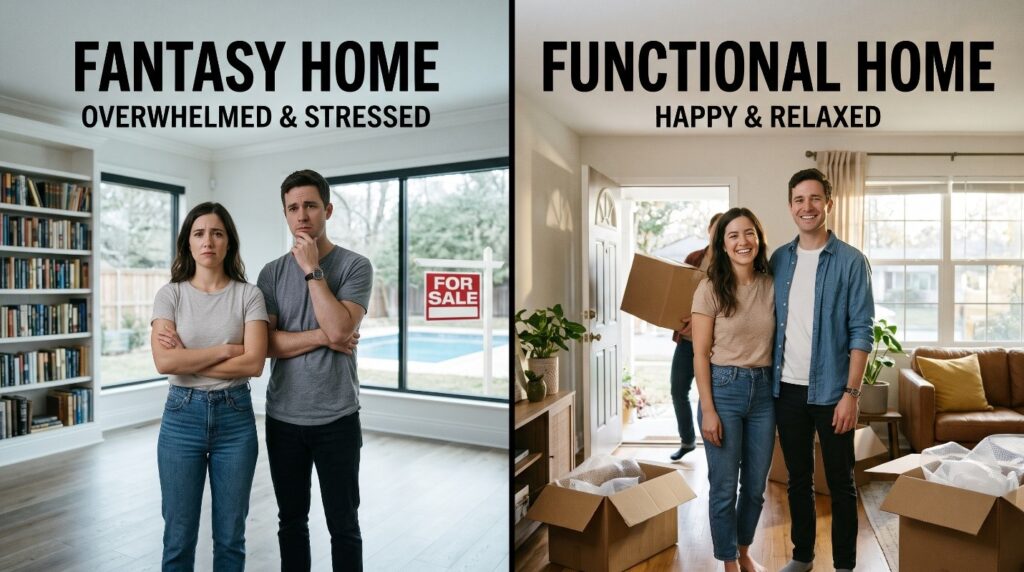
I fell in love with a house that had a library. Floor-to-ceiling shelves. A rolling ladder. A window seat bathed in afternoon light. I could already see myself reading there on Sunday mornings. I almost made an offer that day. Then my partner gently asked a question that stopped me. “Where would we put the children’s beds?” The house had three bedrooms, but one was the library. The others were tiny. The library was a want. The bedrooms were a need. I had almost let a fantasy override a fundamental requirement.
Buying a house is an emotional process. It is also a financial one. The key to making a smart decision is learning to separate what you want from what you need. Wants are preferences. Needs are requirements. Wants are flexible. Needs are not. Confusing the two leads to compromises that you will regret for as long as you own the home.
The first step is to define your needs. These are the non-negotiable features that your life requires. They are not about preference. They are about function. How many bedrooms do you need for your family? How many bathrooms? Do you need a home office because you work remotely? Do you need a first-floor bedroom for an aging parent? Do you need a garage for your car or your hobbies? Do you need to be in a specific school district? Do you need accessibility features? These are not things you can compromise on without significantly impacting your daily life. Make a list. Be honest. Be specific.
The second step is to define your wants. These are the features that would be nice to have but are not essential. A fireplace. A pool. A gourmet kitchen. A finished basement. A view. A deck. A walk-in closet. Hardwood floors. These are the things that make a house feel special. They are worth pursuing, but they are not worth sacrificing a need for. Make a separate list. Be just as honest. It is easy to convince yourself that a want is a need when you fall in love with a house. Writing it down helps you stay grounded.
The third step is to rank your wants. Not all wants are equal. Some matter more than others. You might be willing to compromise on a pool but not on a fireplace. You might be willing to accept a smaller kitchen if it means a larger backyard. Rank your wants in order of importance. This ranking will become your tiebreaker when you are comparing multiple homes that meet your needs. It will also help you decide when a house is good enough, rather than waiting for a house that has everything.
The fourth step is to set a budget that accounts for both needs and wants. It is tempting to stretch your budget to get the house with all the wants. But stretching too far creates financial stress that can overshadow the joy of the features you love. A pool is not enjoyable if you cannot afford to maintain it. A gourmet kitchen is not enjoyable if you cannot afford to cook in it. Set a budget that allows you to meet your needs comfortably and have some room for wants. Do not let the wants dictate the budget.
The fifth step is to be willing to compromise on wants. No house is perfect. Every house will have something you wish were different. The question is whether that something is a need or a want. If it is a want, you can live without it. You can add it later. You can find a substitute. You can adjust your expectations. If it is a need, you cannot. That is the line. That is the decision.
The sixth step is to revisit your lists as you search. What you thought you needed might change once you start touring homes. What you thought you wanted might become more important as you see what is available. What you thought was a deal-breaker might become negotiable when you find the right house. The lists are not carved in stone. They are living documents. Revisit them regularly. Adjust them as you learn.
The seventh step is to trust your gut but verify with your head. If you walk into a house and it feels right, that is important information. But feelings can be misleading. Check your feelings against your lists. Does the house meet your needs? Does it have enough of your wants? Can you afford it? Will it work for your life, not just your fantasy? The best house is the one that feels right and functions right. The library house felt right. It did not function right. I let it go. I found another house. It does not have a library. It has three bedrooms that fit my family, a kitchen that works, and a backyard where my children play. It has what we need. And that is enough.
References
1. Freddie Mac. (2026). *Making a homebuying wish list*. [https://myhome.freddiemac.com/blog/homebuying/making-homebuying-wish-list](https://myhome.freddiemac.com/blog/homebuying/making-homebuying-wish-list)
2. Consumer Financial Protection Bureau. (2024). *Find the right home*. [https://www.consumerfinance.gov/owning-a-home/explore/find-the-right-home/](https://www.consumerfinance.gov/owning-a-home/explore/find-the-right-home/)
3. Freddie Mac. (n.d.). *Finding the right home*. [https://myhome.freddiemac.com/buying/finding-the-right-home](https://myhome.freddiemac.com/buying/finding-the-right-home)