
 Posted by
I almost lost my first house because of a down payment. Not because I did not have one, but because I misunderstood how much I actually needed. I had saved diligently for years, watching my savings account grow with a mix of pride and anxiety. When I started house hunting, I assumed my savings were enough. Then my lender explained the difference between a twenty percent down payment and a lower one. He showed me the numbers. The monthly payment difference was hundreds of dollars. The private mortgage insurance added another layer of cost I had not anticipated. I had been preparing for the wrong target.
A down payment is the portion of a home’s purchase price that you pay upfront, in cash, rather than financing through a mortgage. It is expressed as a percentage of the total price. If you buy a three hundred thousand dollar home with a ten percent down payment, you pay thirty thousand dollars at closing and finance the remaining two hundred seventy thousand. The down payment is not a fee. It is equity from day one. It is the portion of the home you actually own.
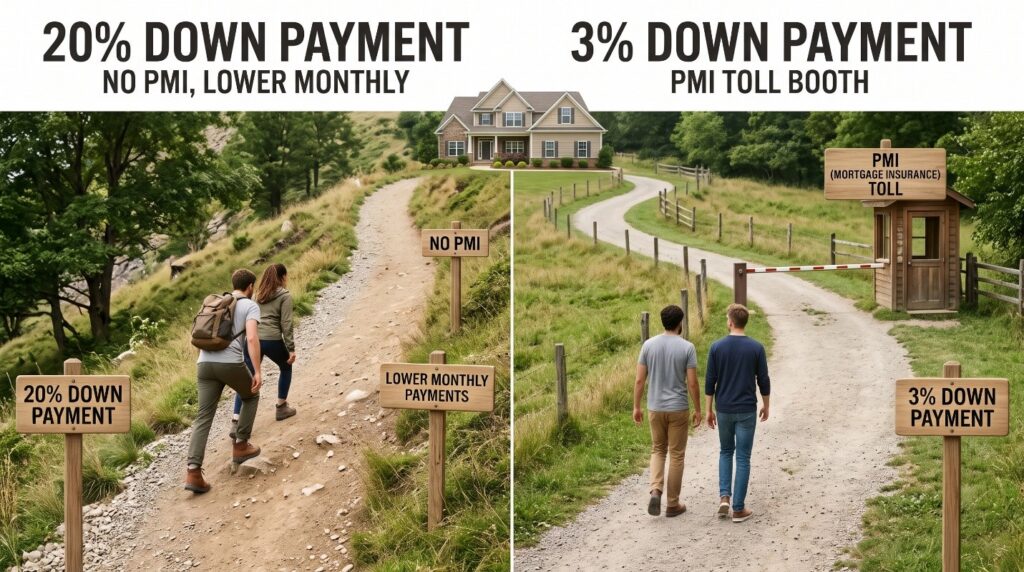
The first thing I learned is that twenty percent is not mandatory. It is a benchmark, not a rule. Conventional loans allow down payments as low as three percent for qualified buyers. FHA loans allow as low as 3.5 percent. VA loans allow zero percent down for eligible veterans. The twenty percent myth persists because it is the threshold at which private mortgage insurance is no longer required. But it is not a legal requirement. Millions of buyers purchase homes with less.
The second thing I learned is that private mortgage insurance is the hidden cost of a low down payment. When you put down less than twenty percent on a conventional loan, your lender requires PMI. This insurance protects the lender if you default. It does not protect you. It adds to your monthly payment, often between 0.5 percent and 1.5 percent of the loan amount per year. On a two hundred seventy thousand dollar loan, that is one hundred thirty-five to four hundred dollars per month. The cost adds up quickly. It can be removed once you reach twenty percent equity, either through appreciation or additional payments. But until then, it is a real expense.
The third thing I learned is that the down payment affects more than the monthly payment. It affects your interest rate. Lenders often offer lower rates to borrowers with larger down payments because they represent less risk. It affects your loan-to-value ratio, which is a key metric lenders use to evaluate risk. It affects your closing costs, which are often calculated as a percentage of the loan amount. A larger down payment reduces the loan amount and therefore reduces closing costs. It affects your equity position from day one. A larger down payment means you own more of your home immediately. That equity can be tapped later for renovations, emergencies, or investments.
The fourth thing I learned is that there are ways to get help with a down payment. Down payment assistance programs exist at the state and local level. They offer grants, low-interest loans, and deferred loans to eligible buyers. Many are targeted at first-time buyers, low-to-moderate income buyers, and buyers in specific professions like teachers, nurses, and first responders. Some employers offer down payment assistance as a benefit. Some nonprofit organizations provide grants. I wish I had known about these programs before I started saving. They could have changed my timeline.
The fifth thing I learned is that the source of your down payment matters. Lenders want to know where the money came from. They need to verify that it is not from an illegal source and that it is not borrowed in a way that increases your debt burden. They will ask for bank statements, gift letters, and documentation of any large deposits. Gift funds are allowed, but they require a letter from the donor confirming that the money is a gift, not a loan. I learned to document everything and to ask my lender about the requirements before I started moving money around.
The sixth thing I learned is that the down payment is not the only upfront cost. Closing costs, moving expenses, and immediate repairs all require cash. I had saved for the down payment but left myself cash-poor. I learned to budget for the full picture, not just the headline number. The best down payment is one that leaves you with reserves for the unexpected.
I bought my house with ten percent down. I paid PMI for three years. I eventually refinanced when my home value increased and my equity crossed twenty percent. The PMI disappeared. The monthly savings were significant. I learned that a lower down payment is not a mistake. It is a trade-off. It got me into a home years earlier than I would have otherwise. It built equity over time. It gave me a place to live and grow.
The down payment is one piece of a complex puzzle. It matters. It shapes your mortgage, your monthly payment, and your long-term costs. But it is not the only thing that matters. Speak with a lender early. Understand your options. Explore assistance programs. Budget for the full picture. And remember that the right down payment is the one that works for your life, not the one that fits a myth.
References
1.Consumer Financial Protection Bureau. (2026). *Determine your down payment*. [https://www.consumerfinance.gov/owning-a-home/prepare/determine-your-down-payment/](https://www.consumerfinance.gov/owning-a-home/prepare/determine-your-down-payment/)
2. Freddie Mac. (2025). *Budgeting for upfront homebuying costs*. [https://myhome.freddiemac.com/blog/homebuying/budgeting-upfront-homebuying-costs](https://myhome.freddiemac.com/blog/homebuying/budgeting-upfront-homebuying-costs)
3. Consumer Financial Protection Bureau. (2022). *Mortgage key terms*. [https://www.consumerfinance.gov/consumer-tools/mortgages/answers/key-terms/](https://www.consumerfinance.gov/consumer-tools/mortgages/answers/key-terms/)