 Posted by
I almost gave up on buying a home before I even started. My credit score was not perfect. My savings were modest. Every mortgage calculator I tried told me I was not ready. Then a friend mentioned FHA loans. I had heard the term but never understood what it meant. I assumed it was some kind of government handout, not a real option for someone like me. I was wrong. Learning about the different types of home loans available changed everything. It turned an impossible dream into a plan.
Not all mortgages are created equal. Different loan programs are designed for different buyers with different financial situations. Understanding the distinctions between them is one of the most important steps in the home buying process. The right loan can mean the difference between qualifying and not qualifying, between a manageable monthly payment and a suffocating one, between a smooth closing and a stressful one.
Conventional loans are the most common type of mortgage. They are not backed by the government. They are offered by private lenders and often sold to Fannie Mae or Freddie Mac. Conventional loans typically require a credit score of at least 620, though better scores get better rates. Down payments can be as low as three percent for qualified buyers, but anything less than twenty percent usually triggers private mortgage insurance, which adds to the monthly cost. Conventional loans are a good fit for buyers with strong credit and stable income.
VA loans are offered through the U.S. Department of Veterans Affairs. They are available to veterans, active-duty service members, and surviving spouses. VA loans are widely considered the best mortgage product on the market. They require no down payment. They have no private mortgage insurance requirement. They often offer lower interest rates than conventional or FHA loans. The VA guarantees a portion of the loan, which protects the lender and allows them to offer better terms. The process can take longer than other loan types, and there are strict property condition requirements, but for those who qualify, VA loans are unmatched. I learned that many veterans do not use their VA benefit simply because they do not know it exists. That is a tragedy. It is one of the most valuable benefits available.
USDA loans are another option, though less well known. They are backed by the U.S. Department of Agriculture and are designed for rural homebuyers. They offer zero down payment and competitive rates, but the property must be in an eligible rural area. Many people assume rural means remote farmland. In reality, many suburbs and small towns qualify. It is worth checking the eligibility map.
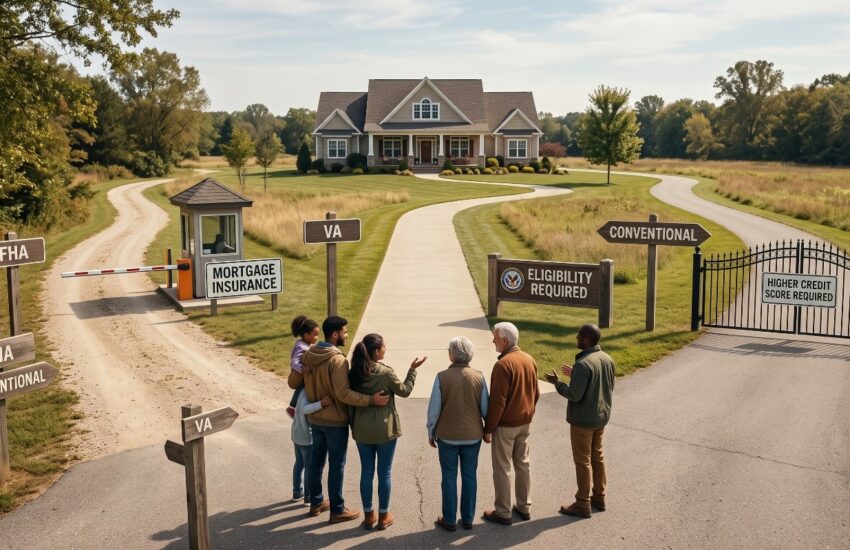
Each loan type has trade-offs. FHA loans are easier to qualify for but carry mortgage insurance. VA loans are generous but limited to veterans. Conventional loans are flexible but require stronger credit. USDA loans are affordable but geographically restricted. The best loan for you depends on your credit, your savings, your military status, and where you want to live.
The most important thing I learned is to talk to multiple lenders. Not all lenders offer all loan types. Not all lenders have the same rates. Not all lenders are equally experienced with government-backed programs. I spoke with three lenders before choosing one. I asked each of them to explain the differences between FHA and conventional for my specific situation. I asked which one would cost me less over the long term. I asked about the total cost of each option, not just the interest rate. One lender took the time to run the numbers both ways. That is the one I chose.
Understanding your loan options is not just about qualifying. It is about making a decision that serves you for the life of the loan. The wrong loan can cost you thousands of dollars in unnecessary fees. The right loan can make homeownership affordable and sustainable.
I did not give up on buying a home. I found the right loan for my situation. And I learned that the mortgage world is not designed to keep people out. It is designed to offer options, if you know where to look.
References
1. Consumer Financial Protection Bureau. (2026). *Understand the different kinds of loans available*. [https://www.consumerfinance.gov/owning-a-home/explore/understand-the-different-kinds-of-loans-available/](https://www.consumerfinance.gov/owning-a-home/explore/understand-the-different-kinds-of-loans-available/)
2. U.S. Department of Housing and Urban Development. (2026). *HUD housing counselors training module 2.2 study guide*. [https://hudhousingcounselors.hud.gov/wp-content/uploads/2026/08/study-module-2-2.pdf](https://hudhousingcounselors.hud.gov/wp-content/uploads/2026/08/study-module-2-2.pdf)
3. PNC Bank. (2026). *The 5 main types of mortgage loans: Which is right for you?* [https://www.pnc.com/insights/personal-finance/borrow/the-5-main-types-of-loans.html](https://www.pnc.com/insights/personal-finance/borrow/the-5-main-types-of-loans.html)
4. State Farm. (2026). *Types of mortgages and how they compare*. [https://www.statefarm.com/simple-insights/residence/compare-different-types-of-mortgages](https://www.statefarm.com/simple-insights/residence/compare-different-types-of-mortgages)
5. Truist. (n.d.). *Planning for homeownership: A step-by-step guide*. [https://www.truist.com/content/dam/truist-bank/us/en/documents/guides-benefits/personal/planning-for-homeownership-a-step-by-step-guide.pdf](https://www.truist.com/content/dam/truist-bank/us/en/documents/guides-benefits/personal/planning-for-homeownership-a-step-by-step-guide.pdf)