

 Posted by
 The house was everything we wanted. Four bedrooms, a renovated kitchen, a backyard with mature trees, and a price that felt almost too good to be true. We made an offer the same day we toured it. It was only later, after we had moved in, that we discovered the truth. The school district was in the middle of a contentious rezoning battle. The quiet street we loved became a cut-through for commuters during rush hour. And the nearest grocery store was a twenty-minute drive. We had done our homework on the house. We had done almost none on the neighborhood.
That experience taught me a lesson I now share with every buyer I meet. You are not just buying a house. You are buying a location, a community, a school system, and a set of daily realities that will shape your life for years. Researching neighborhoods and school districts is not a step you can skip or rush. It is the foundation of a smart purchase.
The first thing I learned is that school districts are not just about test scores. Test scores matter, but they tell only part of the story. I started looking at student-teacher ratios, extracurricular offerings, graduation rates, and the quality of special education programs. I read parent reviews, not just official ratings. I visited schools during drop-off and pick-up to see how they felt, how the staff interacted with students, and whether the environment was welcoming. I also checked whether school boundaries were stable or subject to rezoning. A home that is zoned for a great school today might not be tomorrow.
The second factor is neighborhood safety. I learned to look beyond the headline crime statistics. I visited at different times of day and night. I walked the streets. I talked to neighbors. I checked local crime maps and registered sex offender databases. I also paid attention to smaller signals: street lighting, maintenance of public spaces, presence of neighborhood watch signs. A neighborhood that feels safe during a daytime showing may feel very different after dark.
The third factor is amenities and accessibility. How close is the nearest grocery store, pharmacy, hospital, or park? Is there public transportation? How long is the commute to work? What are the traffic patterns during rush hour? I learned to map out my daily life before committing. Where would I buy coffee? Where would I walk the dog? Where would I take my children to the playground? These small details add up to quality of life.
The fourth factor is future development. A neighborhood that looks quiet today could be the site of a new highway or apartment complex tomorrow. I started checking local planning commission agendas, zoning board minutes, and city council meeting notes. I looked for proposals that could change the character of the area. I also researched economic development plans. A new employer moving in could boost property values. A new landfill could destroy them.
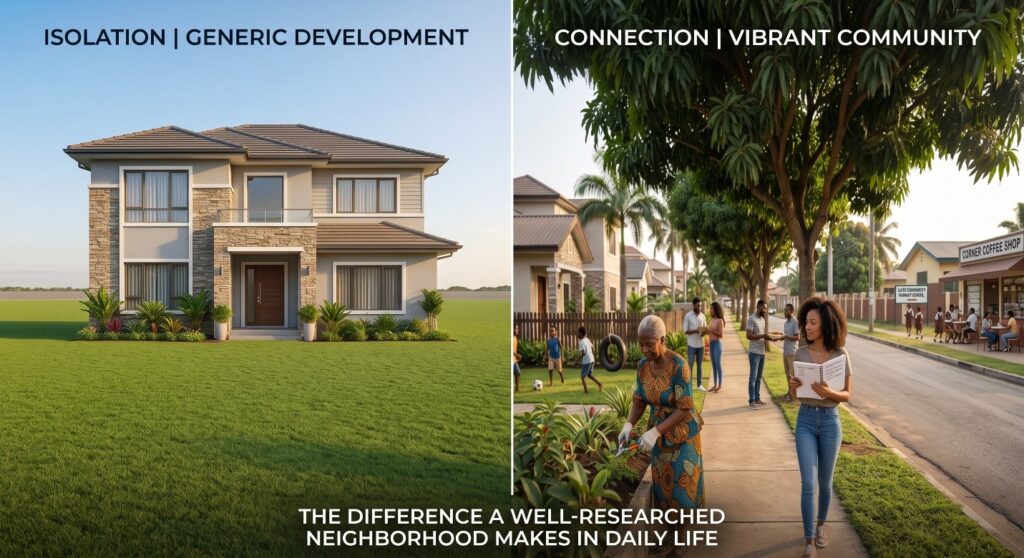
The fifth factor is community feel. This is the hardest to quantify but often the most important. I knocked on doors. I introduced myself. I asked people what they loved about the neighborhood and what they wished were different. I attended a local farmers market and a community meeting. I wanted to know if this was a place where people knew each other, where they looked out for one another, where I could build a life, not just own a house.
I also learned to use online tools wisely. Websites like GreatSchools, Niche, and AreaVibes provide useful data, but they are not gospel. They can be outdated or incomplete. I used them as a starting point, not the final word. The most valuable information came from people, not platforms.
The final lesson was about priorities. No neighborhood is perfect. Every location involves trade-offs. I had to decide what mattered most to me. Was it schools? Commute? Walkability? Quiet? Affordability? Once I clarified my priorities, the decision became clearer.
We eventually sold that first house and bought another one. This time, we researched the neighborhood before we fell in love with the house. We visited on weekdays and weekends. We talked to parents at the local school. We checked the zoning map. We walked to the park. We sat in a coffee shop and watched the community move around us. The house we bought was smaller than the first one. The neighborhood was everything we had hoped for. We have never regretted it.
References
U.S. Department of Housing and Urban Development. (2026, April 23). *HUD empowers real estate agents to better support American homebuyers with information about neighborhood safety and school quality*. [https://www.hud.gov/news/hud-no-26-028](https://www.hud.gov/news/hud-no-26-028)
National Association of REALTORS®. (2026, April 28). *HUD issues “Dear colleague” letter on school and crime data*. [https://www.nar.realtor/news/washington-report/hud-issues-dear-colleague-letter-on-school-and-crime-data](https://www.nar.realtor/news/washington-report/hud-issues-dear-colleague-letter-on-school-and-crime-data)
National Center for Education Statistics. (n.d.). *ED public data frequently asked questions*. [https://nces.ed.gov/ccd/quickfacts.asp](https://nces.ed.gov/ccd/quickfacts.asp)
American Home Shield. (2025, July 9). *The complete first time homebuyer guide*. [https://www.ahs.com/home-matters/homebuyer-hub-resources-and-guides/the-complete-first-time-homebuyer-guide/](https://www.ahs.com/home-matters/homebuyer-hub-resources-and-guides/the-complete-first-time-homebuyer-guide/)
State Farm. (2026, April 28). *How to choose the right neighborhood*. [https://www.statefarm.com/simple-insights/residence/how-to-choose-the-right-neighborhood](https://www.statefarm.com/simple-insights/residence/how-to-choose-the-right-neighborhood)