
 Posted by
 I thought I was ready to buy a home. I had saved for a down payment, researched neighborhoods, and even picked out paint colors in my head. Then my lender pulled my credit score and the conversation changed. The rate he quoted me was nearly a full percentage point higher than the rate he had advertised. Over the life of a thirty-year loan, that difference would cost me tens of thousands of dollars. I had no idea that three digits could carry so much weight.
Your credit score is one of the most powerful numbers in the home buying process. It influences whether you qualify for a mortgage, what interest rate you receive, and how much you ultimately pay for your home. Understanding how it works and how to improve it can save you more money than almost any other preparation you do.
Lenders use credit scores to predict how likely you are to repay your loan. The most common scoring model is the FICO score, which ranges from 300 to 850. The higher your score, the lower the risk you represent to a lender, and the better the terms you are offered. Most conventional loans require a minimum score of 620, while FHA loans allow scores as low as 580. But qualifying is not the same as getting a good deal. The difference between a 620 score and a 760 score can be hundreds of dollars per month.
Your score is calculated from several factors. Payment history is the most heavily weighted, accounting for about 35% of your score. Missing even one payment can cause significant damage that takes months or years to repair. Credit utilization, which is how much of your available credit you are using, makes up about 30%. Keeping your balances below 30% of your limits is ideal, though below 10% is even better. The length of your credit history, the mix of credit types, and the number of new inquiries each play smaller roles.
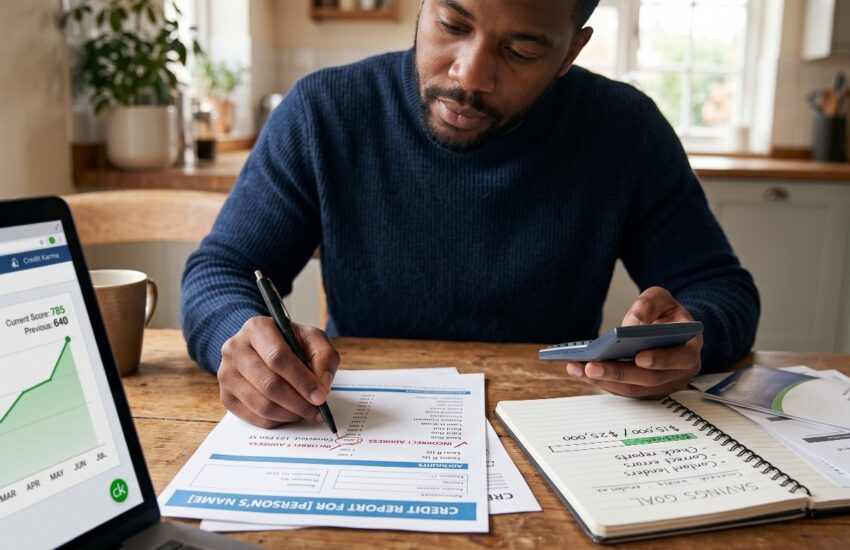
The first step I took was pulling my credit reports from all three major bureaus. Federal law entitles you to one free report from each bureau every year through AnnualCreditReport.com. I reviewed every line for errors. I found an old medical bill that had been sent to collections even though my insurance had paid it. I disputed it, provided documentation, and it was removed within thirty days. That single correction raised my score by nearly forty points.
The second step was addressing my utilization. I had a habit of using my credit cards for everyday purchases and paying them off at the end of the month. But the balances were reported to the bureaus before I paid them, making it look like I was carrying more debt than I actually was. I started making multiple payments per month, keeping my balances low at all times. Within three months, my score climbed.
The third step was patience. I had a few late payments from years earlier that I could not remove. They simply had to age off. There was nothing I could do but wait. That was frustrating, but it taught me that credit repair is not instant. The best time to start improving your score is a year before you plan to buy, not a month.
I also learned to avoid new credit inquiries before applying for a mortgage. Every time you apply for a credit card or a car loan, a hard inquiry appears on your report. One or two inquiries might not matter much, but several in a short period can lower your score and raise red flags for lenders. I stopped applying for store cards and resisted the temptation to refinance my car.
When I finally applied for my mortgage, my score was high enough to qualify for a competitive rate. The difference between that rate and the one I was originally offered saved me over two hundred dollars per month. That was not just a number on a screen. It was real money that stayed in my pocket.
If you are planning to buy a home, start with your credit score. Pull your reports. Fix the errors. Pay down your balances. Be patient. And talk to a housing counselor or lender early. Your credit score is not just a number. It is the key that unlocks the door to your future home.
There is so much more to learn about preparing for homeownership. Our website is filled with articles on mortgages, budgeting, and financial planning. Head over and explore, because the right preparation makes all the difference.
References
Consumer Financial Protection Bureau. (2026, May 20). *Get your money situation in order*. [https://www.consumerfinance.gov/owning-a-home/prepare/get-your-money-situation-in-order/](https://www.consumerfinance.gov/owning-a-home/prepare/get-your-money-situation-in-order/)
Consumer Financial Protection Bureau. (2024, December 30). *Does my credit score affect my ability to get a mortgage loan or the mortgage rate I pay?* [https://www.consumerfinance.gov/ask-cfpb/does-my-credit-score-affect-my-ability-to-get-a-mortgage-loan-or-the-mortgage-rate-i-pay-en-1947/](https://www.consumerfinance.gov/ask-cfpb/does-my-credit-score-affect-my-ability-to-get-a-mortgage-loan-or-the-mortgage-rate-i-pay-en-1947/)
Consumer Financial Protection Bureau. (2017, January 8). *Buying a home? The first step is to check your credit*. [https://www.consumerfinance.gov/archive/blog/buying-home-first-step-check-your-credit/](https://www.consumerfinance.gov/archive/blog/buying-home-first-step-check-your-credit/)
Consumer Financial Protection Bureau. (n.d.). *Your home loan toolkit*. [https://files.consumerfinance.gov/f/documents/cfpb_your-home-loan-toolkit_print_small.pdf](https://files.consumerfinance.gov/f/documents/cfpb_your-home-loan-toolkit_print_small.pdf)
Federal Trade Commission. (2023, November 6). *Credit scores*. [https://consumer.ftc.gov/articles/credit-scores](https://consumer.ftc.gov/articles/credit-scores
Fannie Mae. (2026, April 21). *General requirements for credit scores*. [https://selling-guide.fanniemae.com/sel/b3-5.1-01/general-requirements-credit-scores](https://selling-guide.fanniemae.com/sel/b3-5.1-01/general-requirements-credit-scores)
Fidelity Investments. (2025, July 10). *What credit score is needed to buy a house?* [https://www.fidelity.com/learning-center/smart-money/what-credit-score-is-needed-to-buy-a-house](https://www.fidelity.com/learning-center/smart-money/what-credit-score-is-needed-to-buy-a-house)